
Anarchism
Anarchism and anarchists and anything associated with the thinking, the people, or the history generally get a raw deal from the media and even mainstream historians. It is true that anarchism is profoundly anti-authoritarian, but its popular association with violence (wild-eyed bearded men throwing bombs) is exaggerated, even fictionalized by the very forces threatened by it, namely governments and the media with vested interests in things as they are.
As with any subversive political and economic movement, some proponents became impatient and felt justified in striking out in vengeance or justice. Thus you have Alexander Berkman and his attempted assassination of Pennsylvanian Henry Clay Frick in 1892 and Leon Czolgosz and his successful assassination of President William McKinley in 1901. Berkman, however, served his time in jail, wrote a deep and insightful account of his experience and went on to write more worthwhile books on the subject which possessed his life. (Czolgosz did not have that opportunity, being executed forty-five days after the death of his victim.)
Anarchism survived its dramatic beginnings in the 19th Century, however, and interested readers can find its articulate concern with agricultural reform, labor rights, and prophetic worries about the growth of the surveillance state in many excellent books. Here you will find books and a superb documentary on Sacco and Vanzetti (as well as Woody Guthrie's cd of his investigation into the miscarriage of justice). Here you will find histories, biographies, anthologies, memoirs, and fiction. It is a rich tradition, relevant to this day and to the future.
The Famous Speeches of the Eight Chicago Anarchists
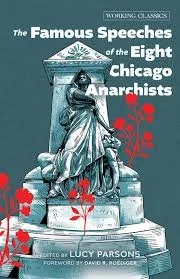
The Famous Speeches of the Eight Chicago Anarchists
Back in print for the first time in decades—a classic in US labor history.
On May 1, 1886, Albert and Lucy Parsons led upwards of 80,000 striking workers and their supporters through the streets of Chicago. Across the country, workers were advocating for the eight-hour day. On May 3, police killed two striking workers on the west side of Chicago. In response, a rally was called for May 4, 1886, at Haymarket Square in Chicago. There a bomb was thrown, eventually killing seven policeman and wounding dozens of others. Eight anarchists were accused: four were hanged, two had their sentences commuted, one served six years, and one died by suicide in his cell. Accused and convicted of conspiracy, the state of Illinois couldn't prove any of them threw the bomb, so they instead tried to kill the anarchist movement. This miscarriage of justice ignited labor movements across the United States and around the world. Collected here are the voices of the accused from their sentencing in the fall of 1886.
For decades after Albert was hanged, Lucy Parsons carried on her husband's legacy through writing, public speaking, and publishing The Famous Speeches of the Eight Chicago Anarchists. The chilling and defiant words of the accused—six of whom were not even at Haymarket Square the night of the bombing—are gripping still, these many years later.
"If you think that you can crush out these ideas that are gaining ground more and more every day, if you think you can crush them out by sending us to the gallows; if you would once more have people suffer the penalty of death because they have dared to tell the truth—and I defy you to show us where we have told a lie—I say, if death is the penalty for proclaiming the truth, then I will proudly and defiantly pay the costly price! Call your hangman!" —August Spies
"For such a government as this I can feel no respect, and will combat them, despite their power, despite their police, despite their spies. I hate and combat, not the individual capitalist, but the system that gives him those privileges. My greatest wish is that workingmen may recognize who are their friends and who are their enemies. As to my conviction, brought about as it was, through capitalistic influence, I have not one word to say." —George Engel
"I will ask you to hang me, too; for I think it is more honorable to die suddenly than to be killed by inches. I have a family and children; and if they know their father is dead, they will bury him. They can go to the grave, and kneel down by the side of it; but they can't go to the penitentiary and see their father, who was convicted for a crime that he hasn't had anything to do with. That is all I have got to say. Your honor, I am sorry I am not to be hung with the rest of the men." —Oscar Neebe
Speeches from August Spies, Michael Schwab, Oscar Neebe, Adolph Fischer, Louis Lingg, George Engel, Samuel Fielden, and Albert Parsons are accompanied by an introduction by Lucy Parsons, foreword by labor historian David R. Roediger, and a public speech from 1901 commemorating the Haymarket anarchists by poet and writer Voltairine de Cleyre.
The Working Classics Series revives lineages of radical thought from the history of the anarchist movement.