Fishing
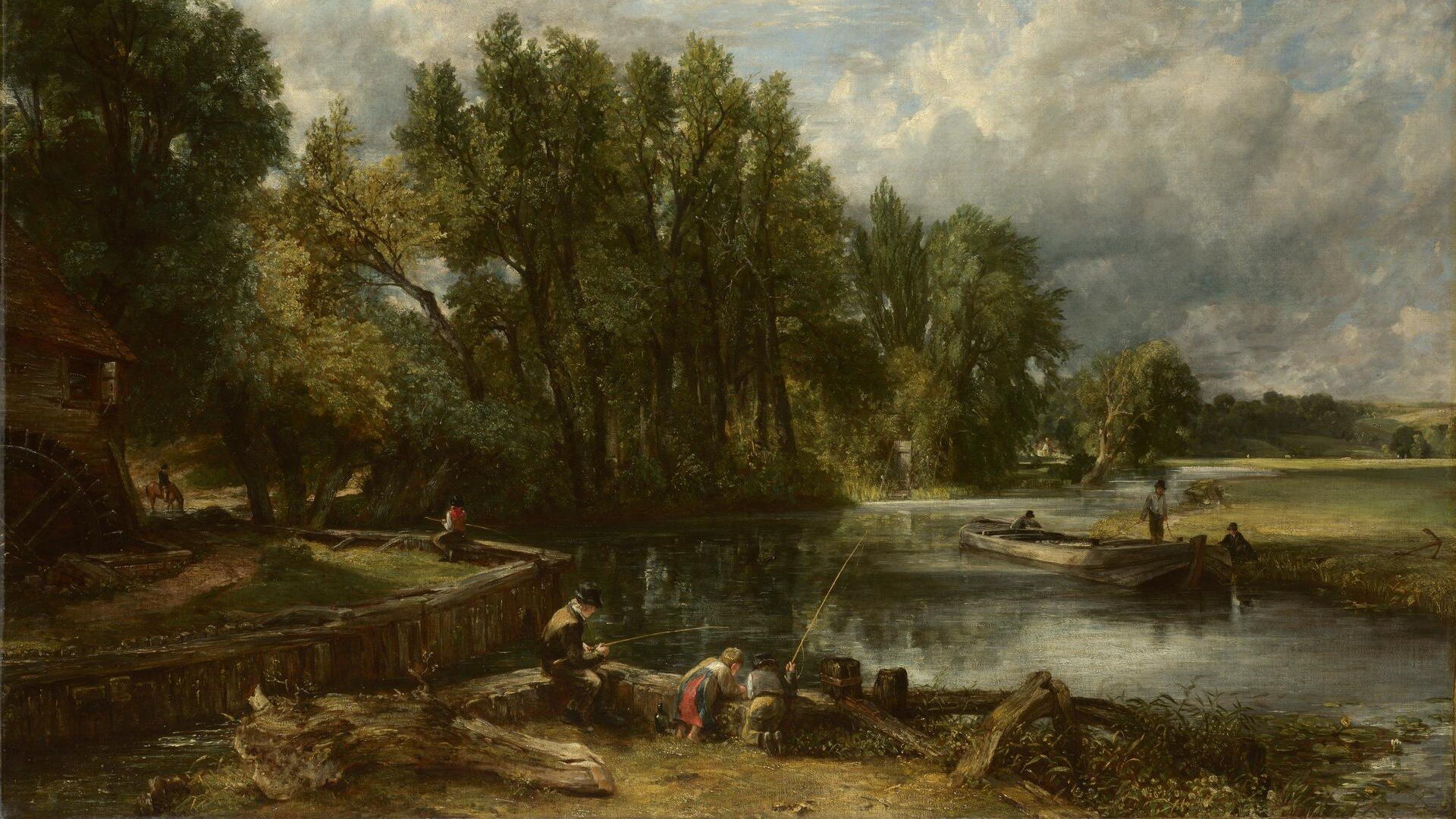
Cumberland Valley, Pennsylvania, where Whistlestop Bookshop is situated, is generously watered and drained by creeks renowned for their fishing. Conodoguinet Creek, which flows about 100 miles to the Susquehanna River and is nearest to Carlisle, is actually better known for the fishing in its two tributaries, Big Spring Creek out of the Newville area (only 5 miles) and Letort Spring Run, which arises south of Carlisle and flows north 9 miles to the Conodoguinet. The Yellow Breeches Creek, which flows along South Mountain for 56 miles to the Susquehanna, is internationally famous for its trout fishing.
Naturally, a trout-fishing and especially a fly-fishing culture has developed, sometimes thought to be mostly local, sometimes acknowledged to be of world interest — the world that loves the quiet and focus and solitary rewards of fly-fishing. Rarely, the local zen masters of fishing wrote books. Charlie Fox was once a customer of Whistlestop, and Joe Humphreys is still in print and in fact the subject of a documentary we carry. Fishing does inspire fine writing, after all — the names of Izaak Walton, Norman MacLean, Thomas McGuane, Patrick McManus, John Gierach suggest the range of approaches in writing about “standing in a river waving a stick,” to use Gierach’s famous descripton.
Dedicated to the memory of a great fisherman and an even better brother, Gordon Wood (1956-2020).
Rigby's Encyclopaedia of the Herring: Adventures with the King of Fishes
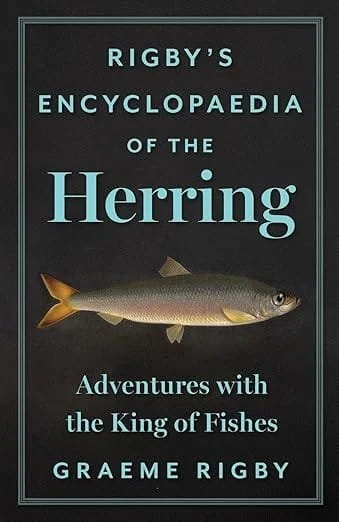
Rigby's Encyclopaedia of the Herring: Adventures with the King of Fishes
This book contains almost everything you didn’t know you needed to know about Atlantic herrings. (Pacific and Baltic varieties are in there too.) Herrings make the world bigger: with spawnings seen from space, a trillion individuals make this one of the tastiest and most abundant vertebrates on Earth.
From ‘A Beginning’ to ‘Zuiderzee’, count the wars fought over herrings; don’t forget Scotland vs the Holy Roman Empire. The herring’s high-pitched farts were logged as Soviet submarines, and one herring joke featured in a Jonson play, four Shakespeare plays and the glorious, suppressed fantasia Nashes Lenten Stuffe. Herrings mock taxonomists; physically change with sea temperature and salinity; stuff predators full to bursting, then swim away.
The Great Sardine Litigation? The true history of kippers? Bloaters? Reds? Chopped herring? Shuba? All this and more. Between sustainable fishery genetics, sixteenth-century Bavaria’s ‘Herrings, herrings, stinking herrings’, and Van Gogh’s ear, every entry is a story, a comic journey, an adventure. Some even come with recipes.
Reviews
‘An infectiously enthusiastic herringist-in-chief, Graeme Rigby has produced a book that will doubtlessly convert others to the cause. . . Surprises and idiosyncrasies . . . are much of the pleasure.’ — TLS
‘A prodigious achievement, by turns erudite and great fun. . . . much enhanced by illustrations, more than 100 in colour.’ — The Spectator
‘An eccentric, encyclopedic feast of a book, glistening with adventures, tales, and facts. This is the book you didn’t know you needed to read.’ — Unseen Histories, New History Books for September 2025
‘Everything you needed to know, and a few things you possibly never needed to know, about the world’s most encyclopaedic fish.’ — Giles MacDonogh, former food and drink writer, Financial Times
‘All there is to know of the herring, the fortunes of the silver darlings, great and small. Bravo Mr Rigby.’ — Jeremy Lee, Chef/Proprietor, Quo Vadis, author of Cooking: Simply and Well, for One or Many
‘I was raised on fried herring on slices of brown bread—to me, that is the very definition of luxury. I have a love for young herring, especially the way it’s savoured in Holland: delicate, with a touch of chopped onion and frozen gin. It’s food that speaks to the soul and this book is nothing short of a delight.’ — Richard Corrigan, Chef Patron of The Corrigan Collection
‘Just like the small but power-packed herring, these encyclopaedic pages are stuffed with a dream-like fishy sufficiency to satisfy the neediest herring aficionado’s appetite; “only nibbling at the edge of the shoal”, doubtful! I’d say. From now on, my world of herrin’ology will never be the same again.’ — Mike Smylie, AKA ‘The Kipperman’, author of Herring: A History of the Silver Darlings
‘It is not inverse snobbery that causes me to prefer herring to salmon. It is, quite simply, a matter of taste. Which is just one of this creature’s manifold properties: for the rest, get reading.’ — Jonathan Meades, journalist, essayist, film-maker, and author of Empty Wigs
‘An incredible insight to hidden histories surrounding the herring trade, Graeme Rigby reminds us why this little sliver darling is so important to understanding the past, the present and learning for the future. Absolutely lush!’ — Joanne Coates, award-winning working class photographer and artist, and curator of the Red Herring exhibition, Helmsdale
‘Graeme Rigby has done for the herring what Pliny the Elder did for everything else. Erudite, eccentric, and unexpectedly moving, this encyclopaedia rescues the herring from obscurity and repositions it—gleaming, iridescent, and gloriously pungent—at the very centre of history. A shimmering feast of facts and fables, with a glint in its eye and a whiff of brine in its wake.’ — Christopher Beckman, author of A Twist in the Tail: How the Humble Anchovy Flavoured Western Cuisine
‘Rigby’s is a treasure trove of all things herring—brimming with dazzling facts, deep history, and irresistible oddities. Dive in and prepare to fall head over heels for the silver stars of the sea.’ — Poul Holm, Trinity Centre for Environmental Humanities, Trinity College Dublin
‘An original, poignant excavation of one of history’s most misunderstood fish. Layering deep scholarship with mischievous wit, Rigby builds a kaleidoscopic monument to the herring’s place in science, culture, war, art, and memory. This is not just a book about a fish—it’s a brilliant meditation on curiosity, storytelling, and the shimmering drift of history itself.’ — David Willer, Department of Zoology, University of Cambridge