
Islam and its World
Islam is the world’s second largest religion with 1.8 billion followers and a majority presence in 49 countries. It is related to Judaism and Christianity in its foundation as a Abrahamic faith, but it considers itself the completed and universal version of a faith that had been historically set forth by Adam, Abraham, Moses, and Jesus. The Qur’an, the unaltered and final revelation of God, is its scripture, its holy book. Details of the faith itself may be found in some of the introductory books we carry.
That said, Islam is also an intriguing historical religion. Its rise in Arabia in the 7th Century (Common Era - it is important to remember that, as with the Jews and many other cultures around the world, calendars are self-defined), its engine of power for the spread of Islamic Civilization across the Middle East, the Mediterranean World, and into Africa and Asia — all are crucial to understanding world history. Islam’s love of science and scholarship, its provocative theories of history, its art and literature — all are deep and complex and rewarding areas of study and commentary.
Islam is also caught up in the high passions and politics of contemporary times. An international web of resources, imperialism, colonialism, nationalism, and shifting alliances keep Islam ever before all peoples. Being a bookseller, I believe the more information, carefully chosen, the better. Hence this page, my gathering of books already stocked here at the store, and as always, a reflection of my paths of understanding Islam.
al-Ghazali's The Incoherence of the Philosophers: A Parrallel English-Arabic Text
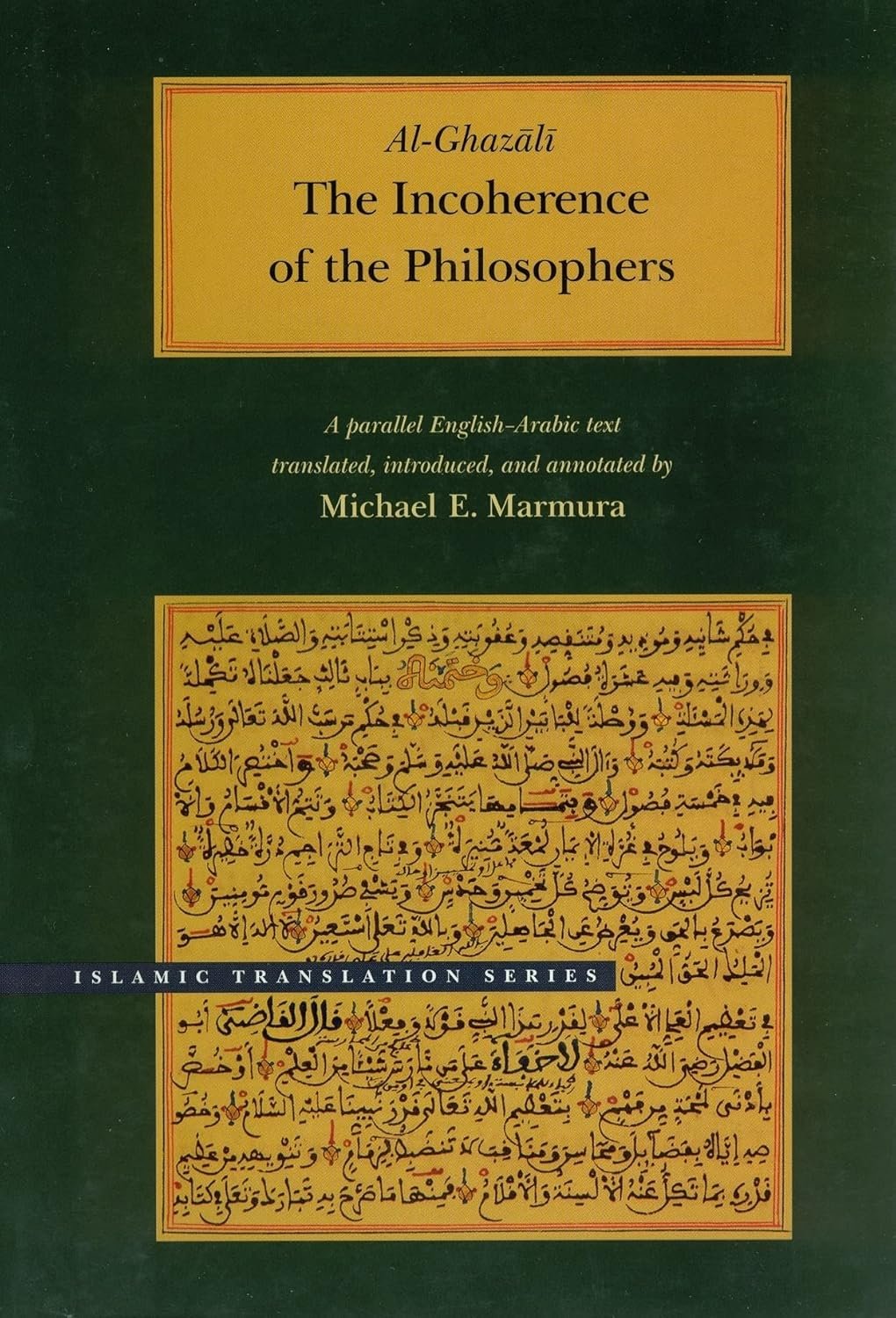
al-Ghazali's The Incoherence of the Philosophers: A Parrallel English-Arabic Text
Although Abu Hamid Muhammad al-Ghazali lived a relatively short life (1058-1111), he established himself as one of the most important thinkers in the history of Islam. The Incoherence of the Philosophers, written after more than a decade of travel and ascetic contemplation, contends that while such Muslim philosophers as Avicenna boasted of unassailable arguments on matters of theology and metaphysics, they could not deliver on their claims; moreover, many of their assertions represented disguised heresy and unbelief. Despite its attempted refutation by the twelfth-century philosopher Ibn Rushd, al-Ghazali’s work remains widely read and influential.