
Islam and its World
Islam is the world’s second largest religion with 1.8 billion followers and a majority presence in 49 countries. It is related to Judaism and Christianity in its foundation as a Abrahamic faith, but it considers itself the completed and universal version of a faith that had been historically set forth by Adam, Abraham, Moses, and Jesus. The Qur’an, the unaltered and final revelation of God, is its scripture, its holy book. Details of the faith itself may be found in some of the introductory books we carry.
That said, Islam is also an intriguing historical religion. Its rise in Arabia in the 7th Century (Common Era - it is important to remember that, as with the Jews and many other cultures around the world, calendars are self-defined), its engine of power for the spread of Islamic Civilization across the Middle East, the Mediterranean World, and into Africa and Asia — all are crucial to understanding world history. Islam’s love of science and scholarship, its provocative theories of history, its art and literature — all are deep and complex and rewarding areas of study and commentary.
Islam is also caught up in the high passions and politics of contemporary times. An international web of resources, imperialism, colonialism, nationalism, and shifting alliances keep Islam ever before all peoples. Being a bookseller, I believe the more information, carefully chosen, the better. Hence this page, my gathering of books already stocked here at the store, and as always, a reflection of my paths of understanding Islam.
Avicenna's The Physics of The Healing Books I and II, 2 volume set: A Parallel English-Arabic Text
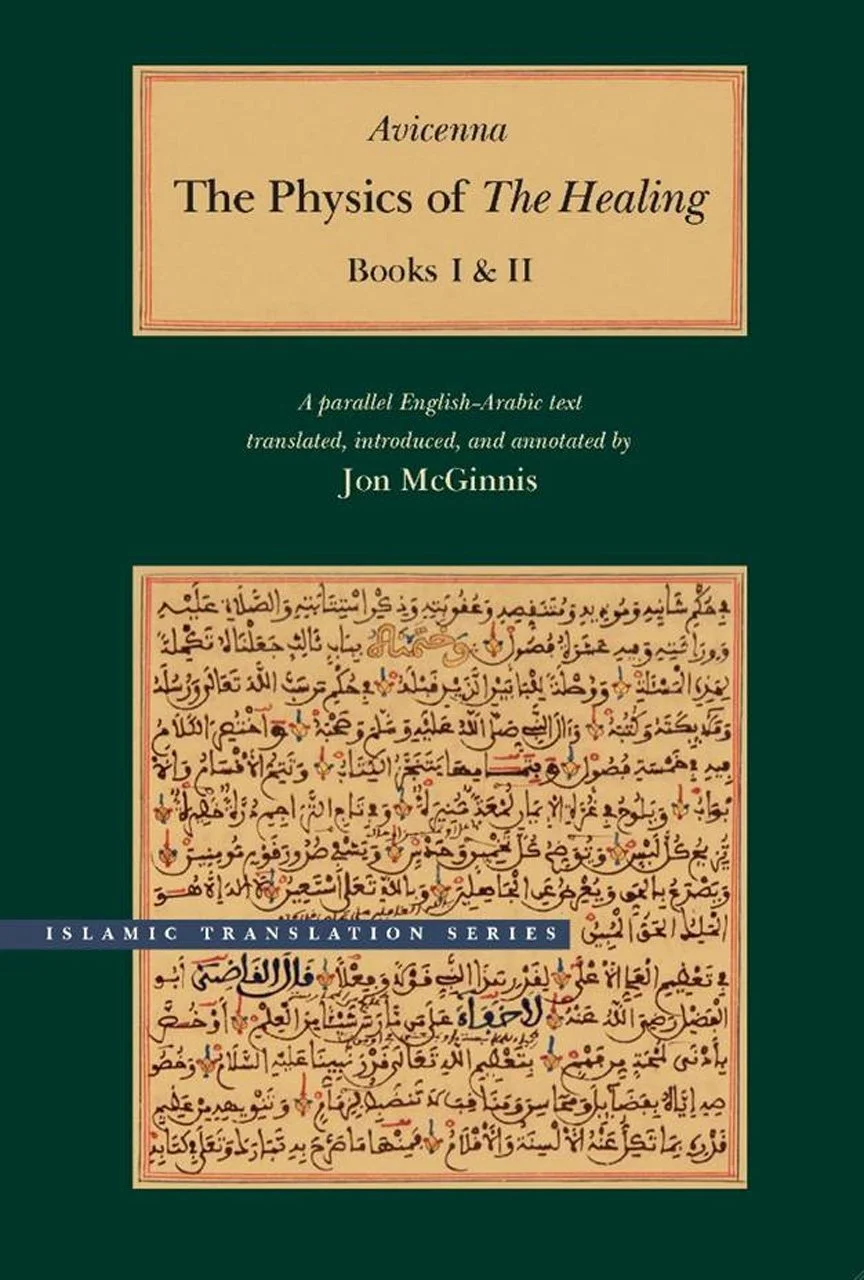
Avicenna's The Physics of The Healing Books I and II, 2 volume set: A Parallel English-Arabic Text
Avicenna’s Physics is the very first volume that he wrote when he began his monumental encyclopedia of science and philosophy, TheHealing. Avicenna’s reasons for beginning with Physics are numerous: it offers up the principles needed to understand such special natural sciences as psychology; it sets up many of the problems that take center stage in his Metaphysics; and it provides concrete examples of many of the abstract analytical tools that he would develop later in Logic.
While Avicenna’s Physics roughly follows the thought of Aristotle’s Physics, with its emphasis on natural causes, the nature of motion, and the conditions necessary for motion, the work is hardly derivative. It represents arguably the most brilliant mind of late antiquity grappling with and rethinking the entire tradition of natural philosophy inherited from the Greeks as well as the physical thought of Muslim speculative theologians. As such, Physics is essential reading for anyone interested in understanding Avicenna’s complete philosophical system, the history of science, or the history of ideas.