
Jules Verne and H.G. Wells
Jules Gabriel Verne (1828-1905), French novelist, poet, and playwright. brought us the 20th Century. Herbert George Wells (1866-1946), English novelist, short story writer, and author of an astonishing range of nonfiction, warned us what Verne’s delivery meant. Both men’s work, unsurprisingly, is immediately and urgently relevant to the 21st Century as well.
Verne was born in Nantes. He had familial, educational, and geographic connections to the sea. He was intended to be a lawyer (his father’s profession), he was educated to be a lawyer, and he was pressured to be a lawyer. He was stubborn, however. By his early 20s he was publishing short stories and cultivating literary friendships in Paris. Theater work and other journalistic pursuits delayed his first novel, Five Weeks in a Balloon, until 1863. All of his work is notable for thorough and meticulous research, a deep interest in technology and human psychology, a style in French that made him influential for generations to come. English translations have failed until recently to live up to the quality of his prose, and his literary reputation has taken longer to be recognized in the Anglophone world. Ray Bradbury, characteristically, summed up Verne’s influence best. In an introduction to Journey to the Center of the Earth, he wrote: “We are all, in one way or another, the children of Jules Verne."
Wells was born in Kent to humble shopkeepers. A broken leg, immobilizing young Wells for weeks, led to a lifelong, almost fanatical devotion to books and reading. Teaching and skill at art were preludes to writing, which began with short stories in his early 20s and exploded onto the literary scene in 1895 with The Time Machine. The Island of Dr. Moreau followed the next year, Wells never slowed down. He wrote far more than “scientific romances.” His best short stories, his World War One novel, his odd and disturbing “horror” stories — all are on par with what his literary contemporaries were doing, including Virginia Woolf, E.M. Forster, Algernon Blackwood, and many others.
The War of the Worlds [Modern Library edition]
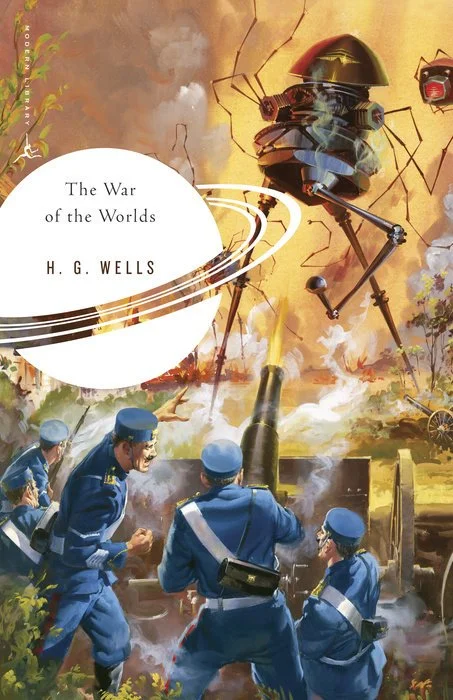
The War of the Worlds [Modern Library edition]
Introduction by Arthur C. Clarke
Commentary by Jules Verne and an anonymous reviewer from The Critic
“No one would have believed in the last years of the nineteenth century that this world was being watched keenly and closely by intelligences greater than man’s and yet as mortal as his own.” Thus begins one of the most terrifying and morally prescient science fiction novels ever penned. Beginning with a series of strange flashes in the distant night sky, the Martian attack initially causes little concern on Earth. Then the destruction erupts—ten massive aliens roam England and destroy with heat rays everything in their path. Very soon humankind finds itself on the brink of extinction. H. G. Wells raises questions of mortality, man’s place in nature, and the evil lurking in the technological future—questions that remain urgently relevant in the twenty-first century.
Includes a Modern Library Reading Group Guide