
KOREAN WAR
In the dry and clinical description of the annalist, the Korean War may be defined as a war between North Korea allied with China and the Soviet Union and South Korea allied with the United Nations and the United States of America. The war began on 25 June 1950 when North Korea invaded South Korea. As always, wars have complex backgrounds. Reasons and factors and inevitabilities are dominoes that later historians set up in the worthy cause of warning the present time and future times not to go down that path.
I will keep this personal and small-scale. My father was a veteran of the Korean War. He was there 1953-1954 with the 7th Infantry Division and was awarded a Bronze Star for meritorious service. He was 23-24 years old there, fresh out of Michigan State University’s ROTC program. We always traded military history back and forth. Late in life he began to tell me stories of his time there — and of his experiences in the Dominican Republic and in Vietnam. As a bookseller I provided him with books on “his” war, which he appreciated for the larger canvas they provided. Here are some of the good ones I have found over the years. I know I don’t have enough of the Korean perspective of the war, and I don’t have many big strategic maps that situate the war within the Cold War. But this listing is a beginning. History is always beginning over. As a discipline, as a way of thought, history never tires of trying to get the story not only right but understandable.
A Morning in June: Defending Outpost Harry
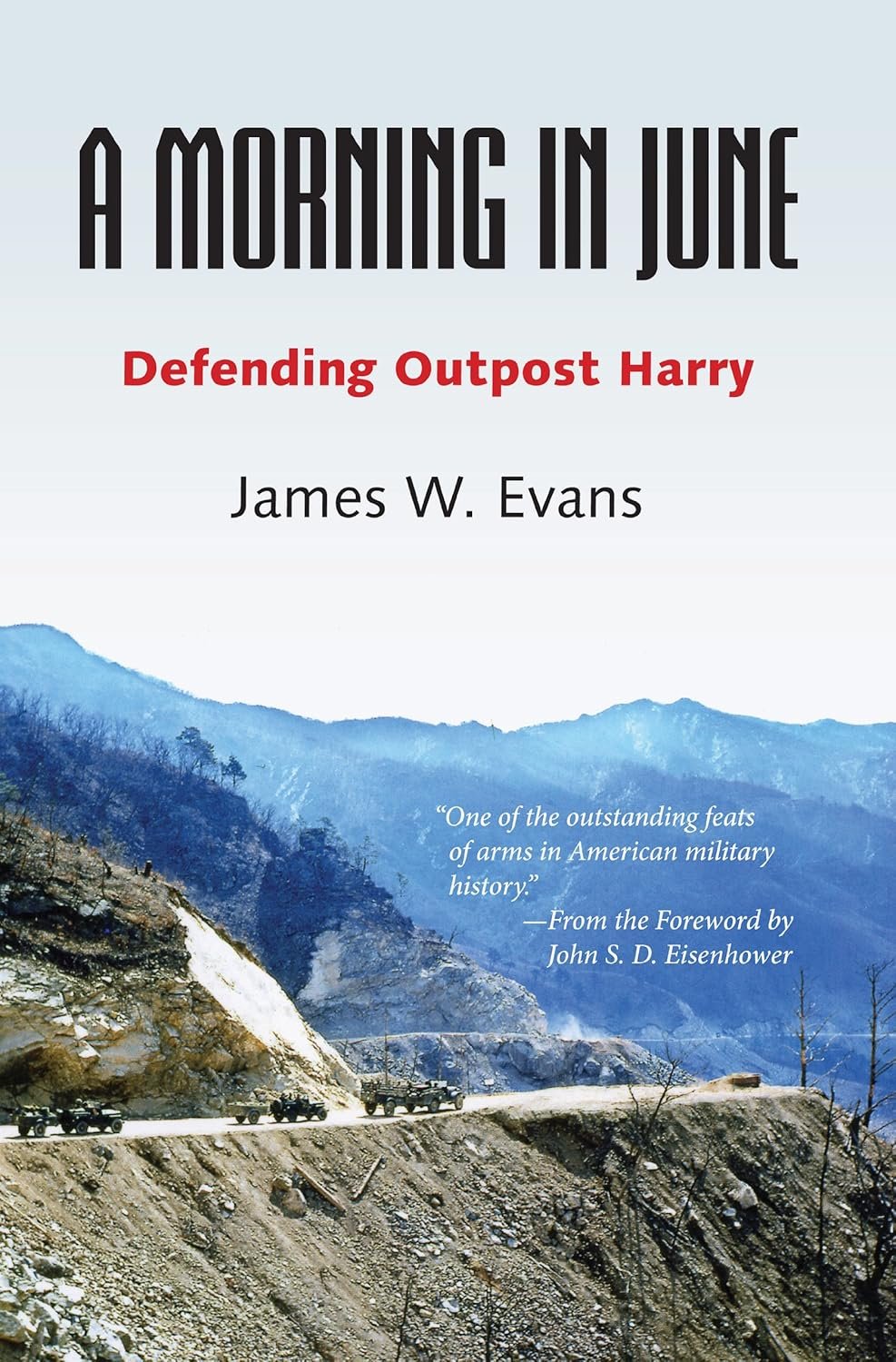
A Morning in June: Defending Outpost Harry
A first-hand account of the defense of Outpost Harry, a strategic position in Korea’s Chorwon Valley brutally contested by the US and Chinese armies as they jockeyed for advantageous positions in anticipation of peace negotiations in Panmunjom. Evans recounts these last days of the war and savage battles for control of important local terrain features against a determined Chinese assault.
By June 1953 the Korean War, marked at the outset by extremely fluid advances and retreats up and down the peninsula, had settled into position warfare very near the original pre-war demarcation line between North and South Korea. At this point both sides were fighting to win a peace, to achieve incremental advantages that could be translated into gains at the peace negotiations in Panmunjom. The battle at Outpost Harry devolved into hand-to-hand combat during a period of constant, intense fighting that lasted two days. The author, although seriously wounded that night, refused evacuation and remained on the hill to successfully lead his company in defense of the outpost. It wasn’t romantic; it wasn’t chivalrous; and many died or were badly wounded. Some of the survivors never fully overcame the mental and physical damage they suffered during the nightmare.
With this book, one of those scarred by that experience recounts the events of the battle and his lifelong efforts to deal with the residual horrors. The Korean Conflict may be called "the forgotten war" by some, but not by those who were on the front lines.
"A heartfelt, honest work. Mr. Evans writes in a humble, straightforward style reminiscent of some of the best Civil War soldier memoirs. He gives the reader a ‘you-are-there’ feel in the book. Indeed, through the author’s narrative I could almost feel the cold of bone-chilling winds coming down from Siberia; hear the shrill whistles, burp gun bursts, and yells of the sea of Chinese infantry surging toward Company A’s positions on Outpost Harry. . . . A Morning in June is not for the faint of heart; it pulls no punches in its description of raw hand-to-hand combat almost prehistoric in its savagery." —Richard D. Goldblatt, retired Army Intelligence Officer