
Malcolm X
Malcolm X (1925-1965) is one of the great prisms of American history and society. A number of national and cultural topics, broken through the refraction of his life and actions and thought, yield a spectrum of perspectives, histories, and controversies. To approach what is called race in America (its political and cultural significations), you must study Malcolm X. To approach the complex history of civil rights in modern America, you must study Malcolm X. To approach the fascinating history of Islam in America, you must study Malcolm X. The topics proliferate the more you follow the threads. Physical intimidation of African-Americans, the behavioral shipwreck of broken families, the prison experience, rural vs. urban African-American experience, gun control, militancy and the larger society, media involvement in celebrity culture, violence and national identity, transnational connections of religion and skin color, the issue of iconic commemoration and biography — all of these subjects are enriched by the life and words of Malcolm X. He is essential to know.
Malcolm X was born Malcolm Little in Omaha, Nebraska. His emotional life was scarred by a violent and alienated childhood, his intellectual life was begun in prison, and his spiritual life was ignited by the discovery of an American form of Islam. He had a extraordinary mind, nimble and creative and always alert to new information and perspectives. He had a charismatic ability to move individuals and crowds with his articulation and his skill in making clear and urgent arguments. His autobiography, as told to Alex Haley, is the best place to begin to know him. It is one of the great American autobiographies, easily on par with those by Benjamin Franklin, Henry Adams, Lincoln Steffens, and Emma Goldman, to name a good mix of classics. I also carry his speeches (still no definitive and scholarly collection of those, alas), biographies of him, the landmark portrayal of him by Denzel Washington in Spike Lee’s great film, and some more recent books by a daughter.
Again, to know America, you must know Malcolm X. Be provoked. It would please him.
Malcolm X: The FBI File
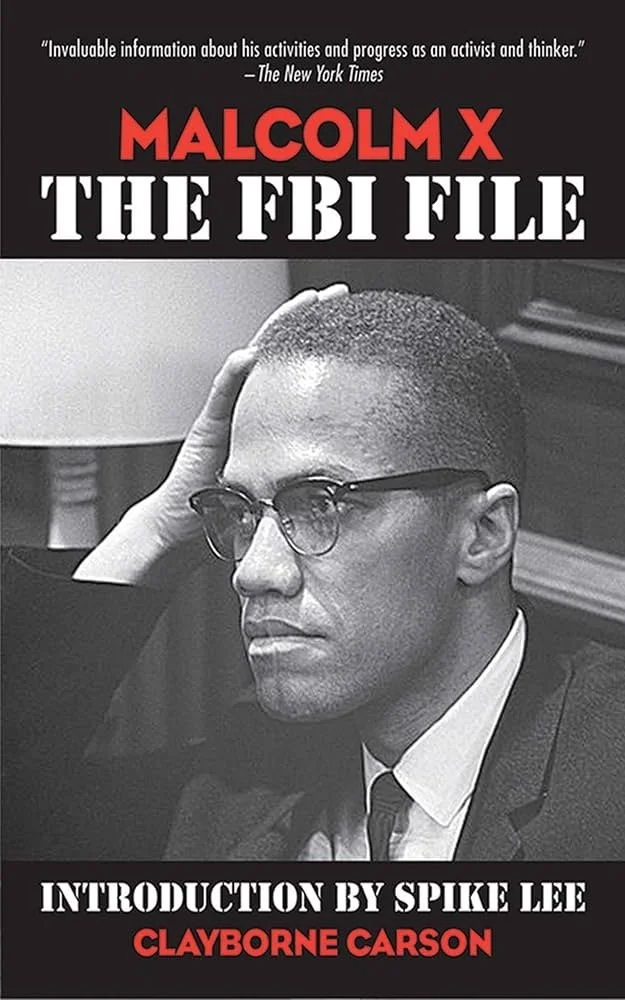
Malcolm X: The FBI File
The FBI has made possible a reassembling of the history of Malcolm X that goes beyond any previous research. From the opening of his file in March of 1953 to his assassination in 1965, the story of Malcolm X’s political life is a gripping one.
Shortly after he was released from a Boston prison in 1953, the FBI watched every move Malcolm X made. Their files on him totaled more than 3,600 pages, covering every facet of his life. Viewing the file as a source of information about the ideological development and political significance of Malcolm X, historian Clayborne Carson examines Malcolm’s relationship to other African-American leaders and institutions in order to define more clearly Malcolm’s place in modern history.
With its sobering scrutiny of the FBI and the national policing strategies of the 1950s and 1960s, Malcolm X: The FBI File is one of a kind: never before has there been so much material on the assassination of Malcolm X in one conclusive volume.