Tarot & Oracle
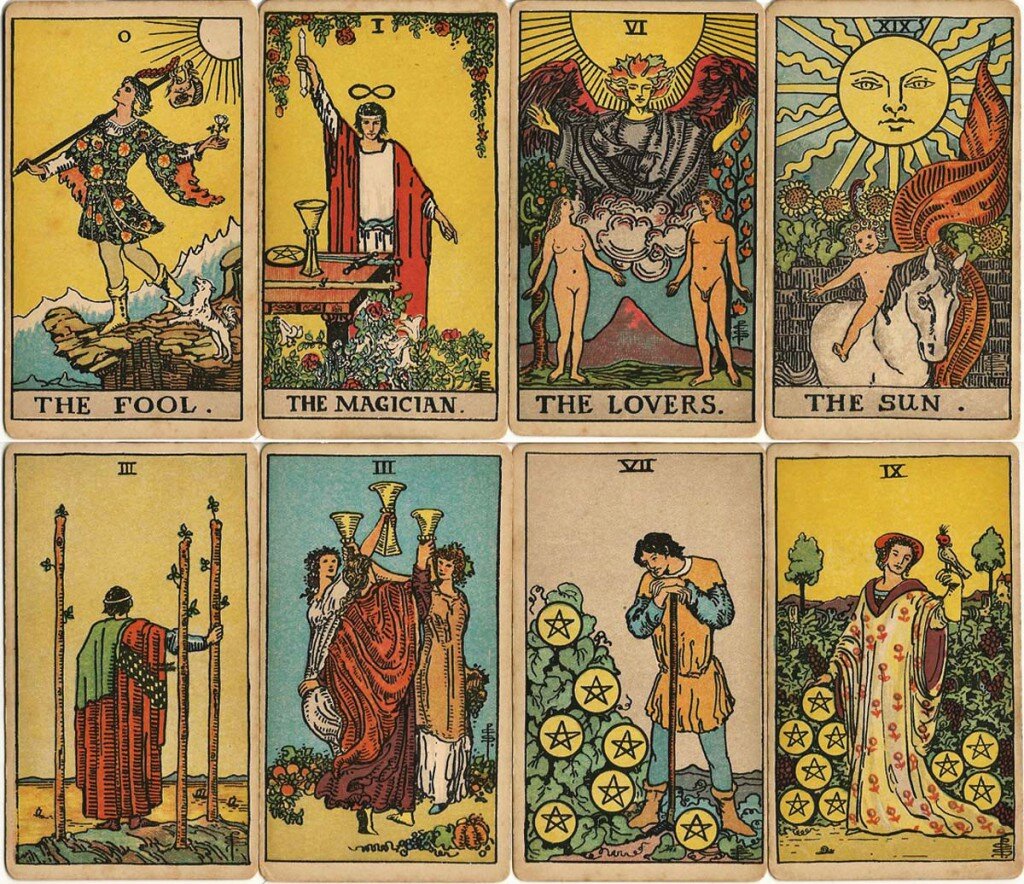
The Tarot is at its tabletop practical basis a deck of decorated cards. Its order and appearance began to be somewhat uniform in the Renaissance, roughly the 15th Century. More complex meanings and purposes of this tool of gamesmanship seem to have begun early in the 18th Century, eventually growing and roaming into the wide spectrum of entertainment, interrogation, divination, and cartomancy that we know today.
A friend introduced me to the I Ching in college, and I quickly understood it to be an effective and enjoyable method of psychological investigation. After years of being put off by some of the more arcane and ambitious claims of tarot enthusiasts, I finally saw the analogy to the I Ching. After many years of resisting carrying the tarot in the store, I now stock it in the simple and inquiring spirit of my understanding. I am attracted to eye-catching art, of course, and I like the idea of cats being involved, of course, although I suspect cats may be more interested in pushing the cards off the table than in being supportive familiars. I respect the tarot’s history, and I will seek out books that place in the context of its origin and survival.
I am aware that the supply and diversity of decks is enormous, but I begin simply and humbly, alert to what my customers like.
Decameron Tarot
Decameron Tarot
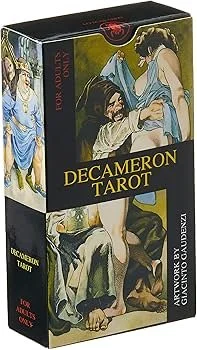
This deck, created by celebrated Italian illustrator Gaudenzi and scholar of erotic culture Spadanuda, bravely plumbs the earthy world of Boccaccio's Decameron. Like other erotic decks, Gaudenzi and Spadanuda amplify the sexual imagination. Unlike other erotic decks, in the Decameron Tarot all sorts of people enjoy the carnal adventure. Ideals of age and beauty vary, and this deck celebrates that variety with great wit and a playful style.
The companion booklets for most Lo Scarabeo decks are in five languages: English, Spanish, French, Italian, and German.