
THE LIBRARY OF AMERICA
The Library of America, a nonprofit publisher and educational outreach entity, was founded in 1979 with grants from the Ford Foundation and the National Endowment for the Humanities. Although its mission was a well-grounded and no-nonsense business approach to publishing, it essentially was fulfilling a long-held dream by the great critic Edmund Wilson and others. The United States of America, they felt, ought to have a publications series of high standards and high quality of production for its national literature, and it ought to reflect the diversity and traditions of all of its writing.
The first books appeared in 1982, when I first began selling new books in an independent book store here in Carlisle. (The founding of Whistlestop Bookshop was three years away.) I still have my copies of Hawthorne, Melville, and Whitman. I won’t tell you how many of the 300+ to date I have acquired, but I am happy to say I never regretted one. The books are remarkably beautiful and efficient and scholarly and finely-made. They are sometimes the only respectable edition available (beware of photo-offset print-on-demand editions!). The accompanying chronologies and notes and textual discussions of every volume are a joy and an education. I cannot praise them too highly.
This listing is what I carry in the store. If you would like other volumes, send me an e-mail or call the store. Enjoy browsing, buying, and owning landmark definitive editions of great writers or great American subjects.
The listings are alphabetical by author except for new or recent anthologies at the top. Older anthologies are at the bottom of the page.
All James Baldwin titles and Ursula K. Le Guin titles are on the respective pages of the authors.
William Kennedy: The Albany Trilogy
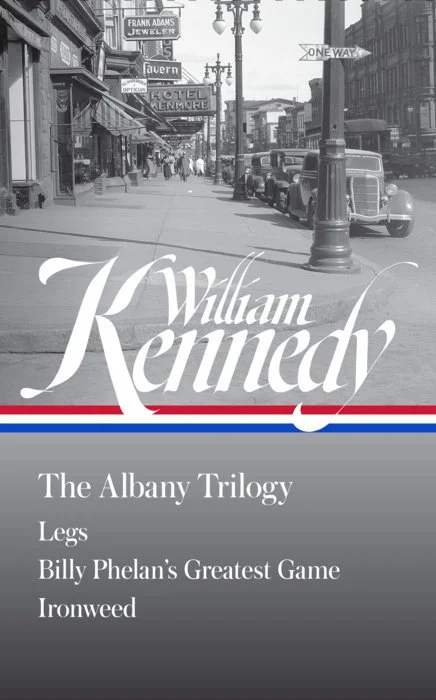
William Kennedy: The Albany Trilogy
A landmark of American historical fiction for the first time in a deluxe collector’s edition
Prohibition-Era Albany comes to life in a trilogy of novels of crime and corruption, hope and redemption
Unfolding in Albany during Prohibition and the Depression, here are three intertwined tales of thwarted yearning, doomed ambition, and hard-won resilience that are now “among the most exuberant literary feats of the past half-century,” as Colum McCann writes in this volume’s Introduction.
Legs (1975) brilliantly envisions the exploits of infamous gangster Jack “Legs” Diamond in the early 1930s. Mining the “truths and secret lies” of Legs’s story, the novel delves deeply into our collective fascination with the underworld, casting Legs’s criminal career as an alternative version of the American Dream—“the dream,” Kennedy writes, “that you can grow up and shoot your way to fame and fortune.”
Billy Phelan’s Greatest Game (1978) strips criminality of all illicit glamour, as its hero, a gambler and pool hustler at the end of his luck, runs afoul of the corrupt Irish American machine that calls the shots in Depression-era Albany.
Ironweed (1983) catapulted Kennedy into overnight literary stardom, earning him a Pulitzer Prize, and a National Book Critics Circle Award. Francis Phelan, Billy’s father and once a promising ballplayer, is now a homeless alcoholic, a haunted wraith of a man who returns to Albany looking to make peace with his life’s misfortunes.
The Albany Trilogy also includes, in an appendix, an essay about Legs Diamonds and the speculation about who might have killed him, along with useful explanatory notes and a newly researched Chronology of Kennedy’s life and career.