
J.R.R. Tolkien
John Ronald Reuel Tolkien (1892-1973) was an English philologist who specialized in an academic pursuit of Old English, Anglo-Saxon, Germanic, and Scandinavian criss-crossings in language — and who conquered the world of popular culture by his creation of the high-fantasy epics of The Hobbit and The Lord of the Rings. He would be the first to agree that often the language created in his mind needed a people and their history to make the creation live, and he had the genius to become deeply interested in what happened to his language-speakers.
Tolkien was a veteran of trench warfare in WWI (reflected in his picture of Mordor). In less than six months he participated in many assaults and lost most of his close friends to the war. He was invalided out with trench fever, a wasting and potentially crippling consequence of the plague of lice in the works. He began a life in academia, eventually carving a distinguished career both for his teaching and his scholarship. His entire adult life, however, had an ever-present onging project with Middle-Earth and its peoples. He published The Hobbit in 1937 and finally finished tinkering with The Lord of the Rings after the war, publishing the three volumes in the early 1950s. The many volumes of his drafts and notes published posthumously by his son Christopher attest to his devotion to languages creating the world and fashioning its history.
It is easy to get lost with Tolkien, trying to track what he wrote when and how revising it affected his fantastic universe in a hundred different ways. It may be helpful when first reading him or even when going back to savor him once again to remember he wanted to find that pre-War England, to take journeys with friends, even if the journeys may be hazardous in a great and noble cause, and to return safely back to a comfortable shire.
The Lord of the Rings: A Reader's Companion
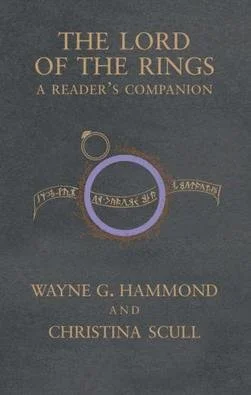
The Lord of the Rings: A Reader's Companion
In The Lord of the Rings: A Reader's Companion internationally acclaimed scholars Wayne G. Hammond and Christina Scull examine Tolkien's masterpiece chapter by chapter, offering expert insights into its evolution, structure, and meaning. They discuss in close detail important literary and historical influences on the development of The Lord of the Rings, connections between that work and other writings by Tolkien, errors and inconsistencies, significant changes to the text during its fifty years of publication, archaic and unusual words used by Tolkien, and words and passages in his invented languages of Middle-earth. Thousands of notes, keyed to standard editions of The Lord of the Rings but universally accessible, reveal the richness and complexity of one of the most popular works of fiction in our time. In addition to their own expertise and that of other scholars and critics, Hammond and Scull frequently draw upon comments by Tolkien himself, made in letters to family, friends, and enthusiasts, in draft texts of The Lord of the Rings, and in works written in later years which amplify or illuminate characters and events in the story. Extensive reference is made also to writings by Tolkien not previously or widely published, including elaborate time-schemes, an unfinished manuscript index to The Lord of the Rings, and most notably, the important Nomenclature or guide to names in The Lord of the Rings prepared for the use of translators, long out of print and now newly transcribed and printed in its entirety. With these resources at hand, even the most seasoned reader of The Lord of the Rings will come to a greater enjoyment and appreciation of Tolkien's magnificent achievement.