
J.R.R. Tolkien
John Ronald Reuel Tolkien (1892-1973) was an English philologist who specialized in an academic pursuit of Old English, Anglo-Saxon, Germanic, and Scandinavian criss-crossings in language — and who conquered the world of popular culture by his creation of the high-fantasy epics of The Hobbit and The Lord of the Rings. He would be the first to agree that often the language created in his mind needed a people and their history to make the creation live, and he had the genius to become deeply interested in what happened to his language-speakers.
Tolkien was a veteran of trench warfare in WWI (reflected in his picture of Mordor). In less than six months he participated in many assaults and lost most of his close friends to the war. He was invalided out with trench fever, a wasting and potentially crippling consequence of the plague of lice in the works. He began a life in academia, eventually carving a distinguished career both for his teaching and his scholarship. His entire adult life, however, had an ever-present onging project with Middle-Earth and its peoples. He published The Hobbit in 1937 and finally finished tinkering with The Lord of the Rings after the war, publishing the three volumes in the early 1950s. The many volumes of his drafts and notes published posthumously by his son Christopher attest to his devotion to languages creating the world and fashioning its history.
It is easy to get lost with Tolkien, trying to track what he wrote when and how revising it affected his fantastic universe in a hundred different ways. It may be helpful when first reading him or even when going back to savor him once again to remember he wanted to find that pre-War England, to take journeys with friends, even if the journeys may be hazardous in a great and noble cause, and to return safely back to a comfortable shire.
The Tower and the Ruin: J.R.R. Tolkien's Creation
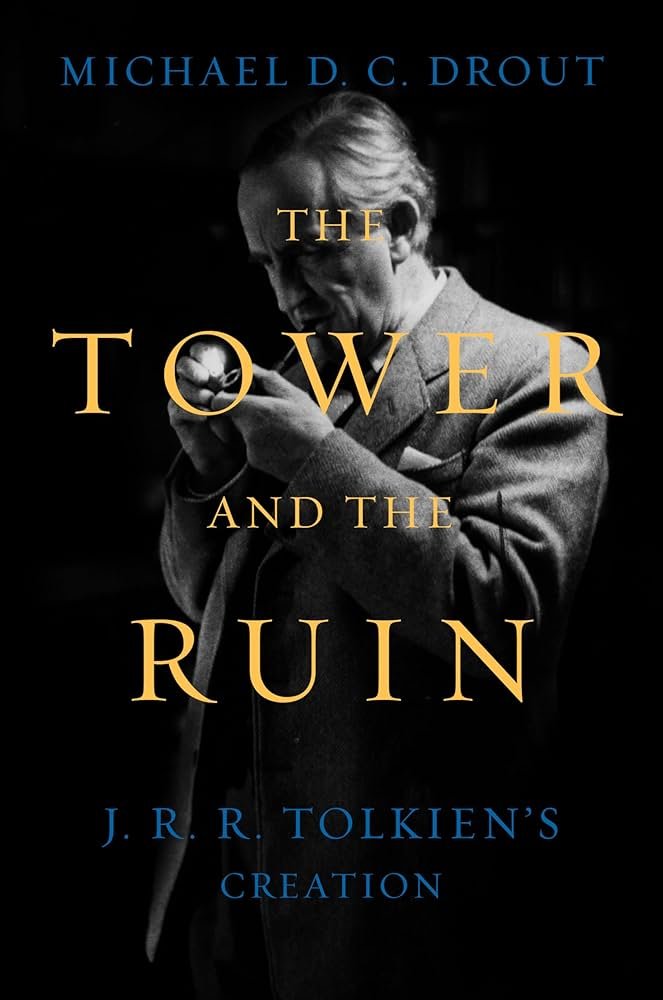
The Tower and the Ruin: J.R.R. Tolkien's Creation
A leading scholar draws on fifty years of reading and studying J.R.R. Tolkien to explain how he created an entire world.
No writer has surpassed the epic achievement of J.R.R. Tolkien, who spent decades refining his Middle-earth—a world that has felt so real to so many readers that it is almost impossible to imagine that any single person could have simply created it, seemingly out of thin air. In The Tower and the Ruin, Michael D. C. Drout takes us deep into Tolkien’s genius, allowing us to glimpse the making of not only The Lord of the Rings, The Hobbit, and The Silmarillion but also lesser-known books such as The Fall of Gondolin as well as Tolkien’s poetry and innovative scholarship.
Drout, who has spent decades reading, studying, and teaching Tolkien, allows us to understand the author’s methods and to embrace his works as never before. With great erudition and sparkling prose, Drout shows us how Tolkien invented myths, legends, cultures, languages, histories, and an intricate, multivocal narrative. We come to understand how Tolkien drew upon and modified material he found in Beowulf, the Kalevala, and other medieval literature from northern Europe, using the subtle qualities of those famous works as inspiration for his own. We also see the process by which he created the complex form of sorrow that is the primary emotional effect of his mature works, a sadness “blessed without bitterness,” carefully woven through a tapestry of themes that has resonated with generations of readers.
Sweeping and hugely perceptive—and enhanced throughout by Drout’s personal reflections on how Tolkien has shaped his own life and relationships—The Tower and the Ruin illuminates Tolkien anew and will come to be seen as an essential work for anyone who has journeyed to Middle-earth.