
World War II (1931-1945)
“The Second World War presented a mirror to the human condition which blinded anyone who looked into it.” — Norman Mailer, “The White Negro: Superficial Reflections on the Hipster” (1957)
Of the endless ocean of books on the Second World War, we have dozens and dozens of new and carefully chosen titles. I define it as beginning with the Japanese Empire’s invasion of Manchuria and ending with not only V-E and V-J Days but also the immediate crises of displaced people, the Soviet Union’s creation of the Iron Curtain, and the growing revelations of the extent of the Holocaust.
In significant ways the Second World War was the defining crucible of the 20th Century. The First World War was prelude, the legacy of the 19th Century’s imperialism, and the Cold War was the sequel. Of the making of books about it there is no end — but the persistence of good research and good writing, and good publication underscores the war’s centrality of the world we live in today and the world our descendents will live in for the foreseeable future.
Advance Britannia: The Epic Story of the Second World War, 1942-1945
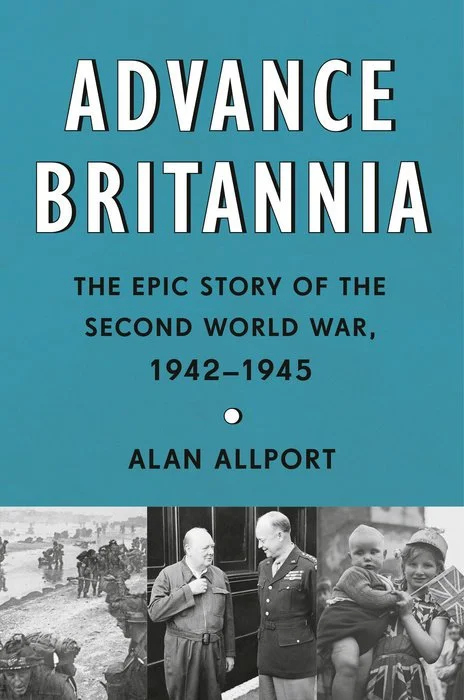
Advance Britannia: The Epic Story of the Second World War, 1942-1945
The author of Britain at Bay—which The Wall Street Journal said may be “the single best examination of British politics, society, and strategy [from 1938 to 1941] that has ever been written”—picks up his sweeping social history in 1942, when what was once a regional war has become an intricate, globe-spanning conflict, with profound consequences for the British Empire and for a British people already exhausted after more than two years of fighting.
“[An] elegant and unsparing history of London’s role in World War II. . . . Overturns one piece of conventional wisdom after another.” —The New York Times Book Review
“The Japanese, gone berserk, have struck in the Pacific, joined up with the Axis, declared war on us,” one British soldier wrote in his diary. “So the Yanks are now our comrades in arms, and the whole world’s ablaze.”
By 1942, Churchill found himself facing a vastly different war than the one he’d inherited from Neville Chamberlain back in 1940. In the East, the Soviets were now a co-belligerent (if not exactly a firm ally). And the aid he’d so longed for from across the Atlantic had finally arrived, when Pearl Harbor pushed America to end its “dithering and buggering about.” But with Parliament and the public losing faith in him, Churchill had to manage a war that now stretched into the Pacific and Indian Oceans, threatening Britain’s colonies, all the while negotiating a new relationship with Roosevelt and Stalin—two jostling, unpredictable comrades-in-arms fully prepared to carve up the world to their own satisfaction.
In this sequel to his prizewinning Britain at Bay, Alan Allport completes his superlative history of Britain’s role in World War II, once again weaving together the political, military, social, and cultural to tell a multifaceted story of a country forced to endure the profound stresses of total war. Now, Britain is no longer at bay. But any victory remains far off, and its costs will be great. Can the British win the war without sacrificing so much along the way that they then lose the peace?