
World War II (1931-1945)
“The Second World War presented a mirror to the human condition which blinded anyone who looked into it.” — Norman Mailer, “The White Negro: Superficial Reflections on the Hipster” (1957)
Of the endless ocean of books on the Second World War, we have dozens and dozens of new and carefully chosen titles. I define it as beginning with the Japanese Empire’s invasion of Manchuria and ending with not only V-E and V-J Days but also the immediate crises of displaced people, the Soviet Union’s creation of the Iron Curtain, and the growing revelations of the extent of the Holocaust.
In significant ways the Second World War was the defining crucible of the 20th Century. The First World War was prelude, the legacy of the 19th Century’s imperialism, and the Cold War was the sequel. Of the making of books about it there is no end — but the persistence of good research and good writing, and good publication underscores the war’s centrality of the world we live in today and the world our descendents will live in for the foreseeable future.
The American School of Spies: The Archaeologists Who Fought the Nazis and Saved the Treasures of Ancient Greece
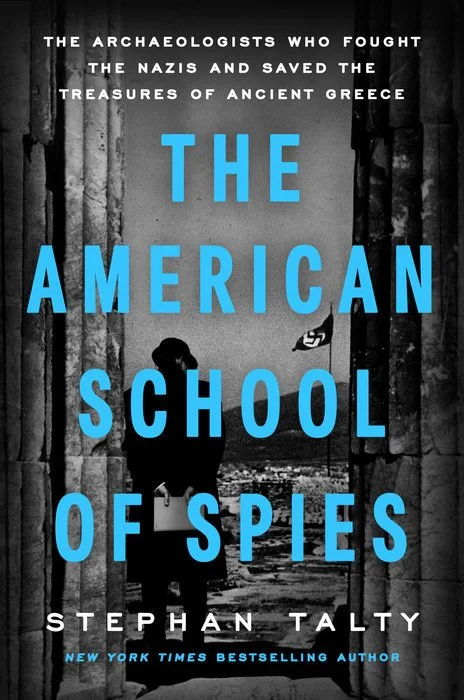
The American School of Spies: The Archaeologists Who Fought the Nazis and Saved the Treasures of Ancient Greece
From the New York Times bestselling author, the incredible true story of the American archaeologists and classicists who went undercover as OSS spies during World War II to fight the Nazis and protect the world’s most precious relics
In 1942, as head of the newly formed OSS, Wild Bill Donovan deployed spies across Europe and around the world to try to thwart the Nazis. In Greece, Nazis weren’t just taking over territory; they were seizing and threatening to destroy some of the world’s most important and valuable historical monuments and artifacts. So, Donovan tapped a young Ivy League-trained archaeologist named Rodney Young to assemble and lead a team of spies to collect intel.
Young set about recruiting the most unlikely of spies—academics, classicists, epigraphers, and other specialists and scholars—who would come to be kown as “the Greek Desk.” These men and women, along with their Greek allies, went undercover and tried desperately to protect some of the world’s most significant treasures. The archaeologists hid priceless artifacts in ancient caves, bank vaults, and even underneath the city of Athens itself. They created fakes to give over to the Nazis to appease their lust for these remarkable works. Ultimately, when it became clear the cat-and- mouse game on its own wasn’t going to save Athens, they brought in an army of Greek American soldiers to beat back the Nazi regime and save their homeland.