
World War II (1931-1945)
“The Second World War presented a mirror to the human condition which blinded anyone who looked into it.” — Norman Mailer, “The White Negro: Superficial Reflections on the Hipster” (1957)
Of the endless ocean of books on the Second World War, we have dozens and dozens of new and carefully chosen titles. I define it as beginning with the Japanese Empire’s invasion of Manchuria and ending with not only V-E and V-J Days but also the immediate crises of displaced people, the Soviet Union’s creation of the Iron Curtain, and the growing revelations of the extent of the Holocaust.
In significant ways the Second World War was the defining crucible of the 20th Century. The First World War was prelude, the legacy of the 19th Century’s imperialism, and the Cold War was the sequel. Of the making of books about it there is no end — but the persistence of good research and good writing, and good publication underscores the war’s centrality of the world we live in today and the world our descendents will live in for the foreseeable future.
The Greatest Naval War Ever Fought
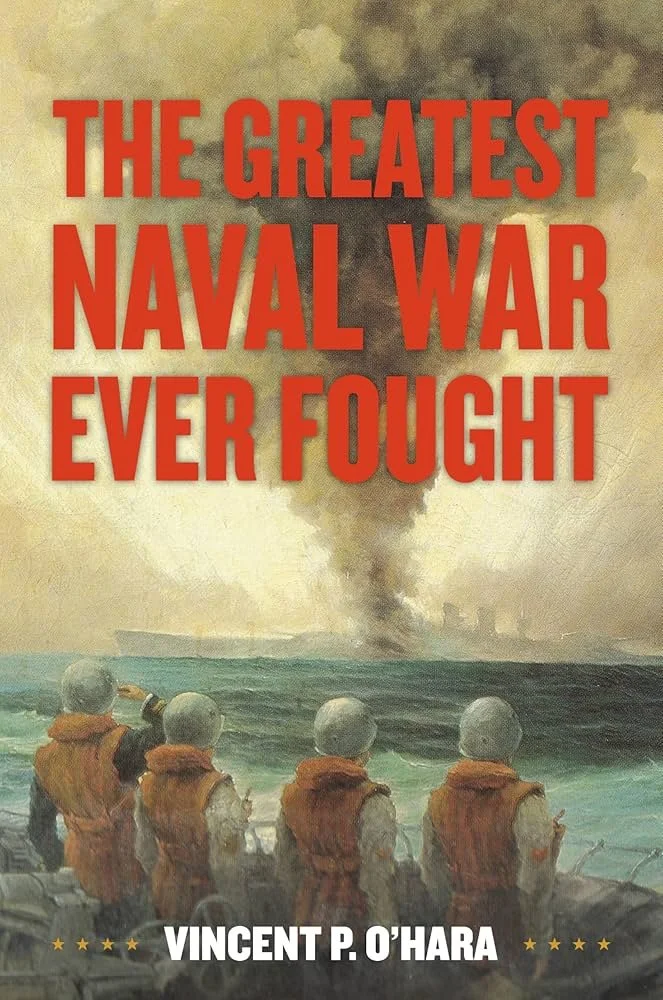
The Greatest Naval War Ever Fought
The greatest naval conflict in history occurred during World War II from 1939 to 1945. Most people are familiar with the famous Battle of the Atlantic and epic naval engagements in the Pacific like Midway and Leyte Gulf, all of which receive ample coverage in this panoramic work. However, author Vince O’Hara offers a truly global perspective of World War II at sea that captures every aspect of a vast naval conflict that involved dozens of nations, more than 15,000 ships, and 43.7 million tons of shipping. Approximately 570,000 lives were lost at sea in those six years.
Here, the naval action begins in the Baltic Sea before dawn on September 1, 1939, when a German battleship opened fire on Polish troops barricaded in a fortress in the port city of Danzig, Poland. Over the ensuing nine months, the conflict spread into Great Britain’s home waters of the North Sea, the English Channel, and the eastern Atlantic. One of the most remarkable naval achievements of the war occurred in 1940 during the German invasion of Norway. The Kriegsmarine’s successful attack in the face of immensely superior Allied naval forces was the war’s first large-scale amphibious operation. As naval activities in Europe expanded into the Mediterranean, the war in the Pacific exploded with the Japanese attack on Pearl Harbor in December 1941. That assault led to a series of critical naval battles between Japan and the United States, including Wake Island, Coral Sea, Midway, and Guadalcanal.
O’Hara not only deftly examines all the major naval contests in the European and Pacific theaters, but also offers detailed analysis of secondary navies such as France, Italy, and the Soviet Union. He explores little-known, smaller engagements such as the campaigns between Thailand and France or Perú and Ecuador. O’Hara connects this broad range of naval action by focusing on recurring themes of technological innovation, command and control, logistics, and intelligence. He demonstrates that there was more than one path to winning sea power and that the most important naval platforms to emerge from the war were the oiler, the Landing Ship Tank (LST), and the Liberty ship—not the aircraft carrier, the submarine, or the battleship. O’Hara makes clear to readers that the impact of the naval battles won by the Allies still reverberates today.
Vincent P. O’Hara is a naval historian and the author, coauthor, or editor of seventeen books including Struggle for the Middle Sea and Fighting in the Dark. He was the Naval Institute Author of the Year in 2016 for Torch. His work has also appeared in many magazines and journals and has been translated into Spanish, Japanese, and Italian. He holds a history degree from the University of California, Berkeley and lives in Chula Vista, California.
Editorial Reviews
Vince O’Hara has done the near-impossible! Here we have a comprehensive history on the naval aspects of World War II that offers new insights and fresh analysis, enhanced by a compelling read. With a plethora of maps, tables, and charts supplementing a well-organized and adeptly written account, this necessarily large and complex story is skillfully illuminated. This may well be O’Hara’s capstone achievement, synthesizing a lifetime of remarkable work into an exceptional addition to the World War II archive.—Thomas J. Cutler, author of Give Me a Fast Ship: The Heroic Actions of Ernest Evans and the Crew of USS Johnston
O’Hara’s broad thematic analysis is a compelling examination of World War II navies and their capabilities. His perspective on World War II provides valuable lessons and important insights, informed by decades of research and robust collaboration with talented historians from around the globe.— Trent Hone, author of Mastering the Art of Command and Learning War